
A billing app
In his GopherCon Africa talk, JB builds a client billing system on stage, from an empty folder, with Grit: clients, the projects done for them, the invoices sent and the payments that settle them. Four tables and three relationships, small enough to build in front of a room and real enough to show what every app runs into.
You will build the same app with Nevela, in shillings, and then fill it with as many records as a real business has. It takes about twenty-five minutes.
It goes faster if you have done Contacts: your first app, which explains nevela resource and the dashboard. You need PHP 8.3 or newer with Composer, and Node.js 20 or newer: Set up your computer says how to get them, if you haven’t yet.
1. Create the app, in shillings
Section titled “1. Create the app, in shillings”nevela new billingcd billingEvery amount in this app is in Uganda shillings. Say so before making anything: open apps/api/.env and add a line at the end.
NEVELA_CURRENCY=UGXAn amount then reads UGX 4,500,000, the form takes whole shillings, and the seeder makes amounts in thousands rather than in cents. (The API takes what it is sent; a column holds two decimals whatever the currency.) Any ISO 4217 code works; see Money and its currency.
nevela devSign in at http://localhost:3000/sign-in as admin@example.com with the password password. Run the commands below in a second terminal, in the same folder.
2. Clients
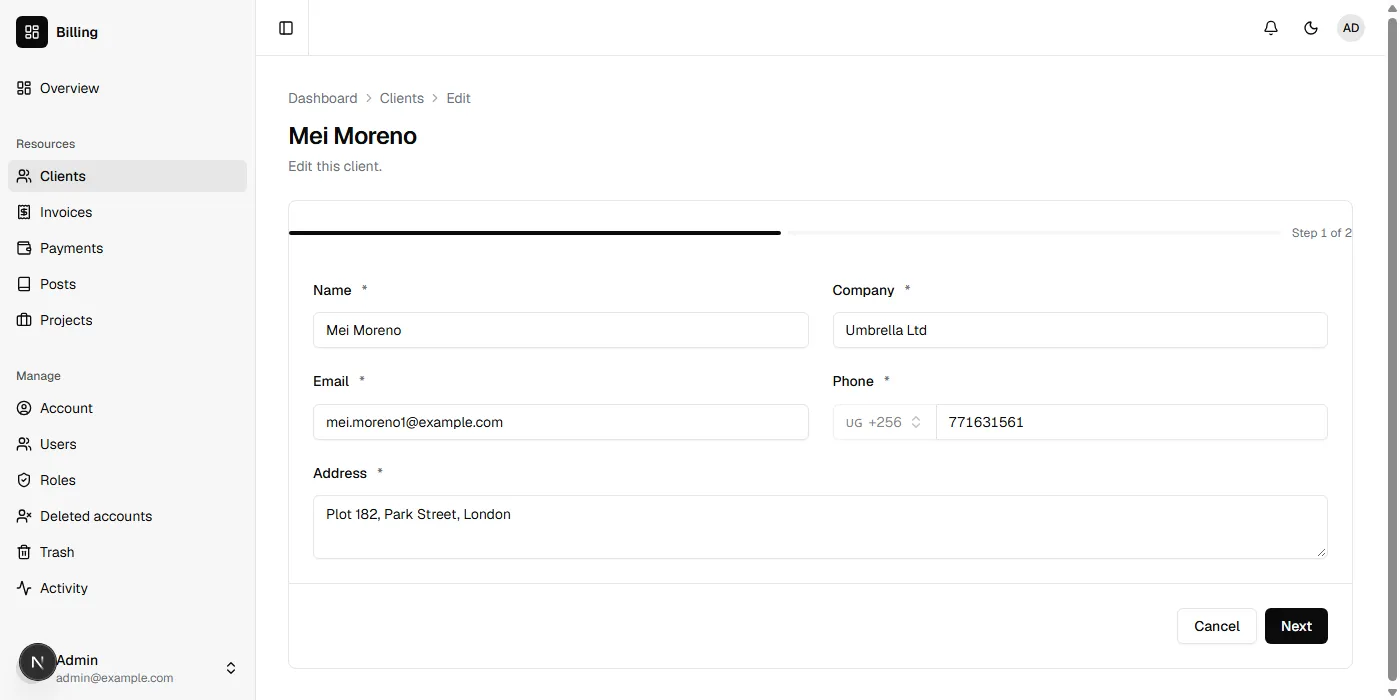
Section titled “2. Clients”nevela resource Client --fields="name:string, company:string, email:email, phone:tel(UG), address:text, photo:image?" --icon=usersA client is a person at a company, with an address and a photo, which is optional (?).
phone:tel(UG) holds a Ugandan number. It is taken the ways people write one there, 0772 123456, 772 123456 or +256 772 123 456, and kept one way, +256772123456, so the same number is always the same. In the form, the country code is fixed at +256. A number from anywhere else is refused: “Enter a Ugandan number, such as 0772 123456 or +256 772 123456.” phone:tel alone takes any country’s. See Phone numbers.
3. Projects
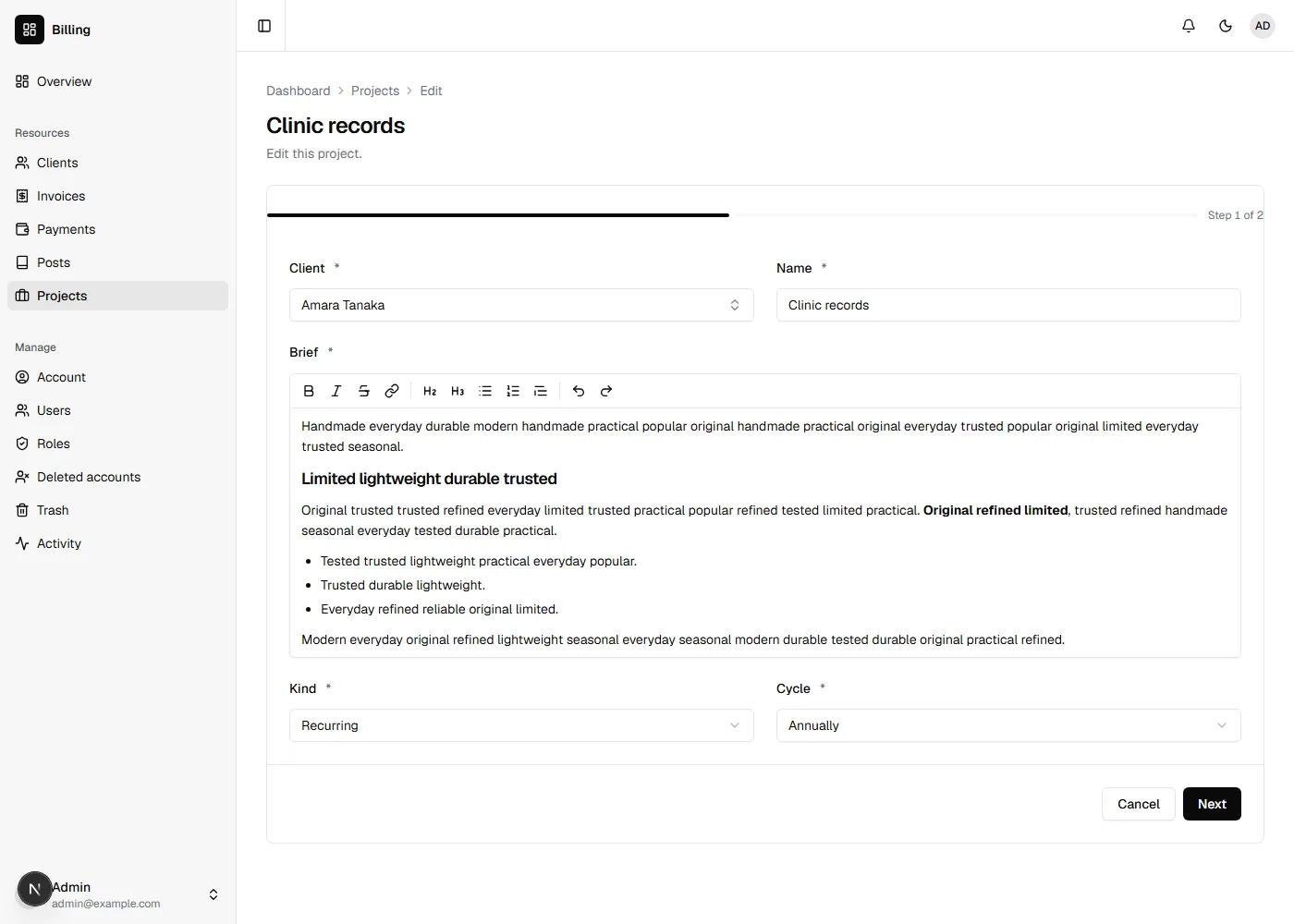
Section titled “3. Projects”nevela resource Project --fields="client:belongsTo(Client), name:string, brief:richtext, kind:enum(one_off=One-off|recurring), cycle:enum(monthly|annually) if kind == recurring, amount:money, starts:date, gallery:files(image)?" --icon=briefcaseA project is done for one client, and has a brief written with headings and lists (richtext), an amount, the day it starts, and a gallery of pictures.
A project is either a one-off or recurring. The value stored is one_off; =One-off is what it is called where people read it, since “One off” is how it would read otherwise.
A billing cycle belongs to a recurring project and means nothing on a one-off one. if kind == recurring says so, and both halves of that rule are kept for you:
| A recurring project | A one-off |
|---|---|
| The form shows Cycle, marked required. | The form doesn’t show it. |
| Saved without one, it is refused: “Needed when the kind is Recurring.” | It has none. One sent anyway, from the API or an import, is not kept. |
Change a recurring project to a one-off and its cycle goes with the change. See A field that only sometimes applies.
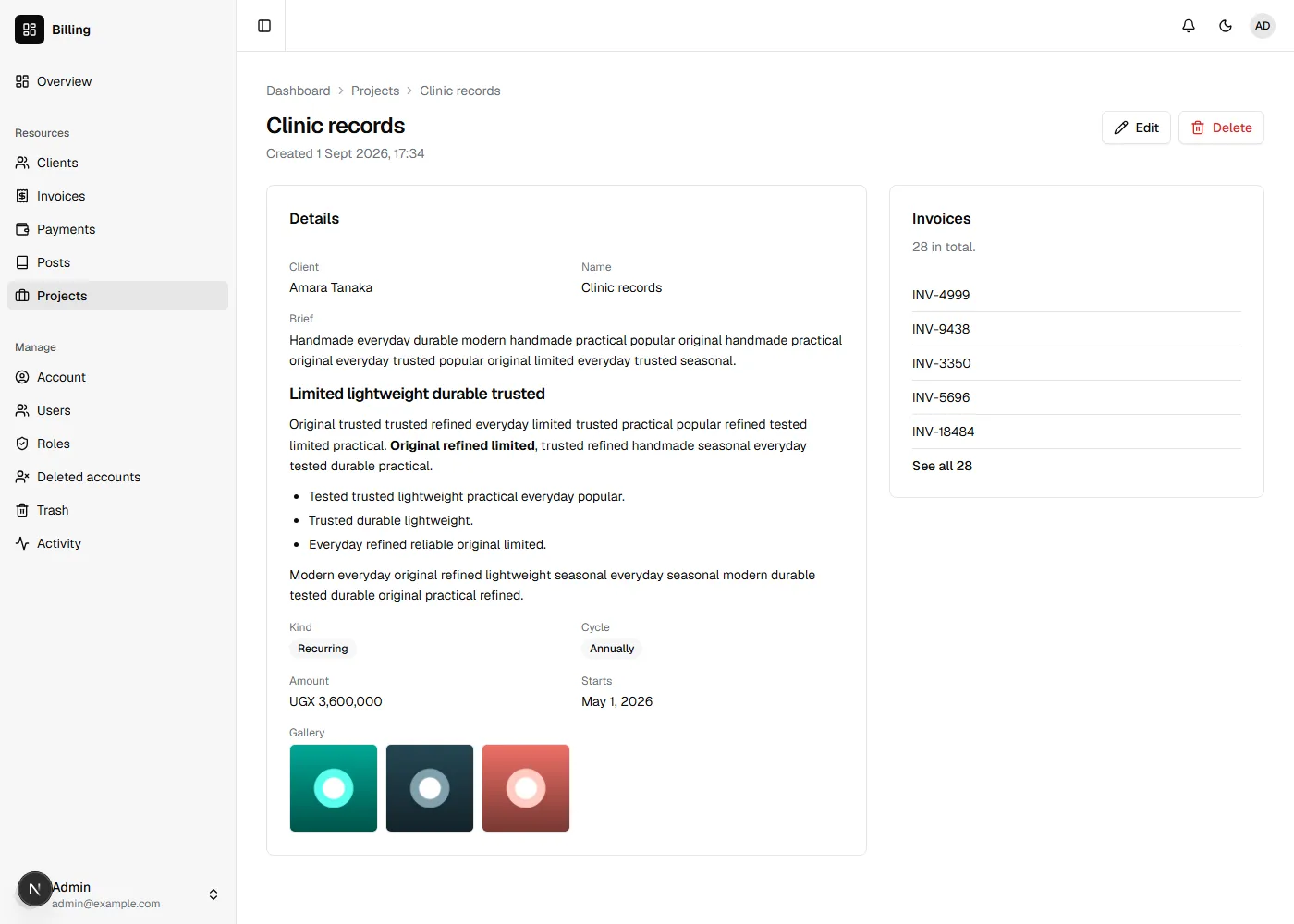
gallery:files(image)? holds up to 20 pictures in the order they were added, each optimised as it arrives. In the form, choose or drop several at once; each shows as a tile you can take out again. See Several files in one field.
4. Invoices and payments
Section titled “4. Invoices and payments”nevela resource Invoice --fields="number:auto(INV), project:belongsTo(Project), amount:money, due:date, notes:text?" --icon=receiptnevela resource Payment --fields="invoice:belongsTo(Invoice), amount:money, paidOn:date, method:enum(bank|card|cash|mobile=Mobile money), notes:text?" --icon=walletAn invoice is sent for a project, and a payment settles an invoice. Each is a belongsTo, so a project’s page lists its invoices, and an invoice’s page its payments.
number:auto(INV) numbers each invoice as it is made, INV-0001, INV-0002 and on, and no two share one. Leave it empty in the form. See Numbered by Laravel.
A payment’s method is stored as mobile and reads Mobile money, in the form, the table, the filters and the export.
5. A business’s worth of records
Section titled “5. A business’s worth of records”A list page that works with twenty records may not with twenty-five thousand. Find out now, not after the app has a year of invoices in it:
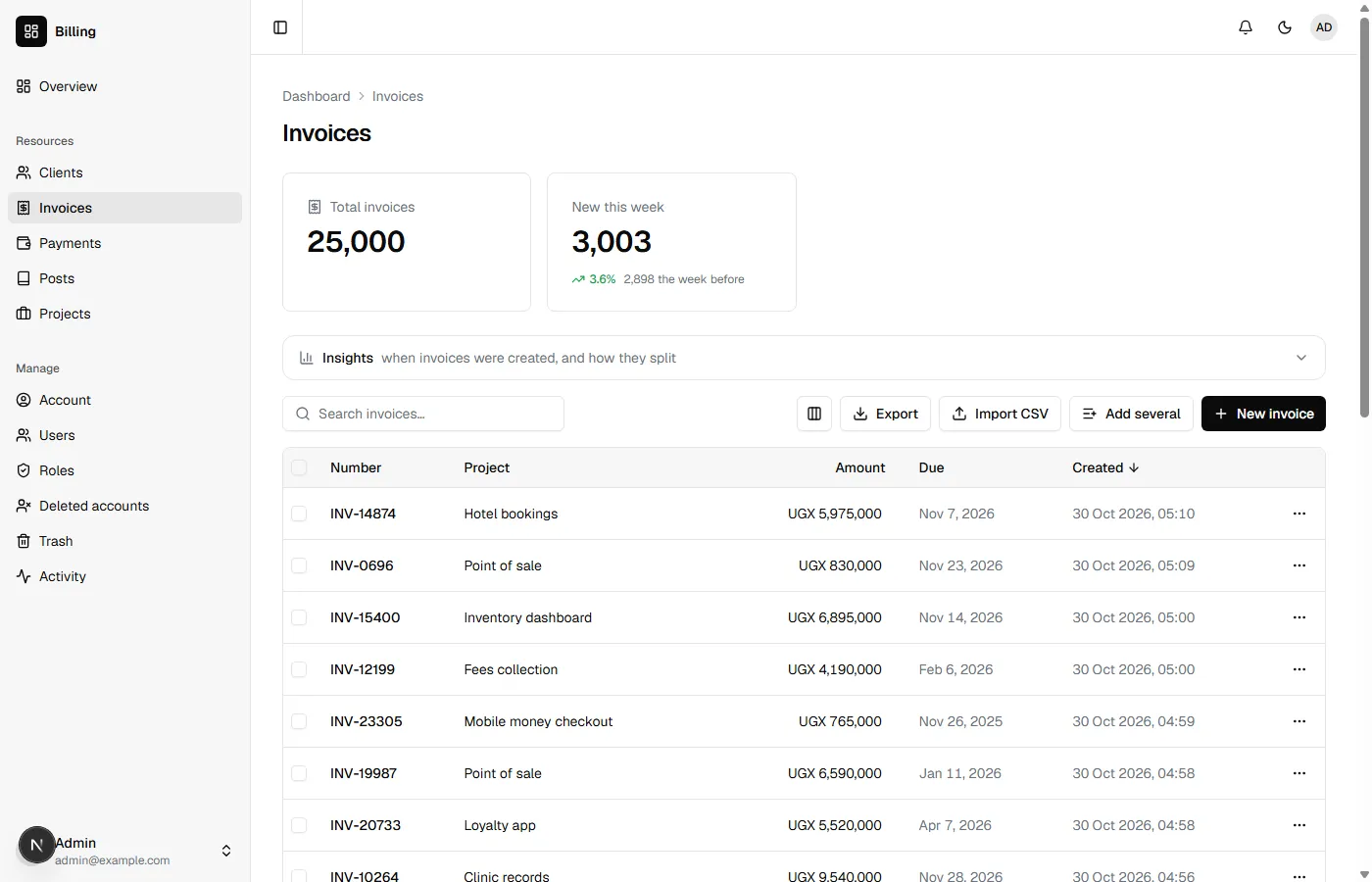
nevela seed Client --count=500nevela seed Project --count=2000nevela seed Invoice --count=25000nevela seed Payment --count=20000Each command says how long it took. The records read like a business’s: a client is a person at a company with a Ugandan number, a one-off project has no cycle and a recurring one does, some projects have pictures, invoices are numbered INV-0001 to INV-25000, and amounts are whole shillings. Each invoice is for one of the projects, and each payment for one of the invoices.
Open Invoices. The list fetches one page at a time, so the first of 25,000 opens as the first of 25 does. Search for INV-12345, sort by the due date, filter by project, and export what you see.
Coming from Grit
Section titled “Coming from Grit”JB’s commands, and Nevela’s for the same field. Most of Grit’s spellings are understood as they are, so you can type what you know:
| Grit | Nevela |
|---|---|
client:belongs_to[Client] |
client:belongsTo(Client), or Grit’s |
kind:select[one_off, recurring] |
kind:enum(one_off|recurring), or Grit’s |
mobile="Mobile money" |
mobile=Mobile money, inside the brackets, or Grit’s |
cycle:select[…] if kind == recurring |
cycle:enum(…) if kind == recurring, or Grit’s |
phone:tel[UG] |
phone:tel(UG), or Grit’s |
photo:file[image] |
photo:image, or Grit’s |
gallery:files[image] |
gallery:files(image), or Grit’s |
number:string:auto:INV |
number:auto(INV), or Grit’s |
paid_on:date |
paidOn:date; the column is paid_on either way |
--faker, then grit seed Invoice --count 25000 |
nevela seed Invoice --count=25000, or --seed=25000 on nevela resource |
What you built
Section titled “What you built”- Clients with a Ugandan phone number, kept in one form.
- Projects whose billing cycle applies to recurring ones only, with a written brief and a gallery.
- Numbered invoices, and payments with a method that reads as people say it, all in shillings.
- A dashboard, an API and a database with 47,500 records in them, to see how the app holds up before a real business fills it.
What a client owes is the sum of their invoices less their payments: an action that sends a client their statement is a good next thing to build. To make an invoice of lines, numbered and ready to print, go on to An invoice app. Seeding has more on filling an app with records. Before the app goes online, read Deploying.